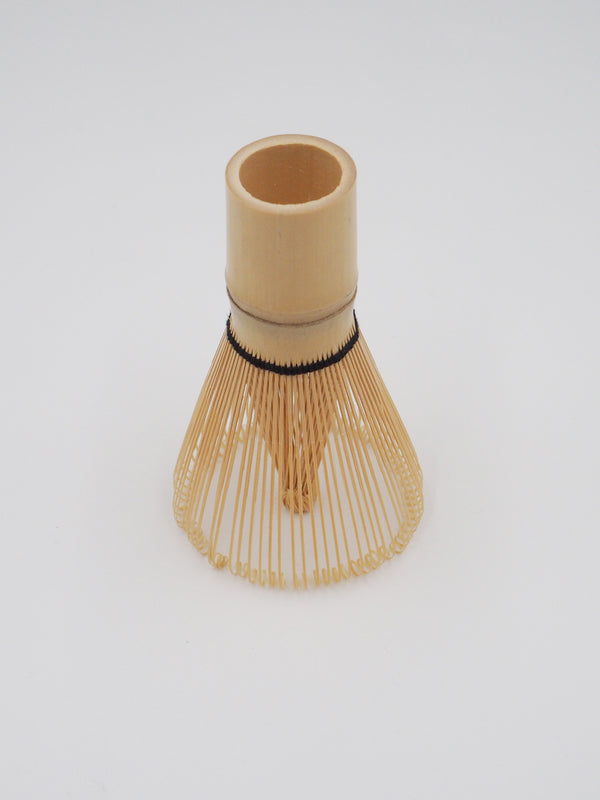
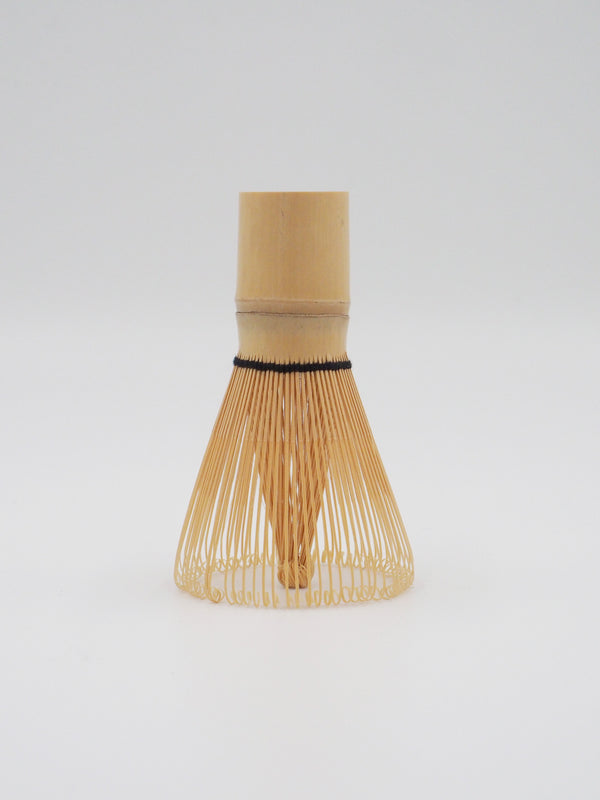
It is a good habit to repeat this process before each use. By letting the whisk soak in hot water for a few minutes, the bamboo straws become softer and more elastic and flexible, which can prevent them from breaking. It also makes it easier to whisk the matcha to a smooth and frothy consistency every time.
Whipping technique
When whisking your matcha, it's important to have the right technique - both to achieve a smooth, frothy tea and to protect your bamboo whisk. Start by holding the whisk lightly in your hand and using soft but quick movements, forming a "W" or "M" in the bowl. These movements help to mix the tea evenly and create a fine layer of foam, which is characteristic of a well-whisked matcha.
Be careful not to touch or scrape the bottom of your matcha bowl. If the bamboo straws hit the bottom of the bowl, you risk them breaking or wearing out quickly. To avoid this, the whisk should be kept slightly suspended in the liquid, so that only the tips of the tines come into contact with the matcha. This protects the whisk and at the same time gives the best consistency to the tea.
Cleaning after use
Once you have finished whisking your matcha and using your bamboo whisk, it is important to clean it to extend its life. After whisking, place the whisk in a bowl of clean, warm water for a few seconds. This will help loosen any matcha residue that may be stuck between the bamboo straws. Then rinse the whisk gently under running water to ensure that all residue is removed. If matcha residue is not rinsed away properly, mold can develop over time, which will not only damage the whisk but also affect the quality of your tea.
Additionally, it is important to never use soap to clean the whisk, as soap residue can penetrate the bamboo straws and damage them, as well as affect the taste of your matcha. The whisk should also never go in the dishwasher, as heat and water pressure can cause the bamboo to crack and the whisk to lose its shape.
Drying and storage
After cleaning your bamboo whisk, it is important to dry it properly to ensure that it remains in good condition. The most effective method of drying the whisk is to place it on a holder designed for bamboo whisks . This holder ensures that the whisk retains its original shape and prevents the tines from bending or breaking.
The picture shows an example of two whisks that have been in use for a long time, where one (right) has been dried on a stand, and therefore keeps its wide, beautiful shape better than the other (left), which has been dried without a stand, and therefore has become narrower in shape.

The holder also allows air circulation, which helps prevent moisture from building up, reducing the risk of mold. If you don't have a holder, you can leave the whisk to dry upright on its handle. However, this is not the best solution, as excess water can collect in the handle and create moisture, and eventually mold.
Avoid storing your bamboo whisk in its plastic packaging. Pressing the whisk back into this packaging can weaken the shape of the whisk and the bamboo straw.
By following the above tips for maintaining your bamboo whisk, you will be able to use it for up to one to two years at best. If you notice that the bamboo straws on your whisk are starting to thin or break, it is time to consider investing in a new one.